Yearly Archives: 2013

E-Verify = National ID

Over at Huffington Post, David Bier goes into some detail on how the innocuous sounding “E-Verify” may very well morph into a biometric National ID system. The comments following the article were quite depressing – the all too willing sheep take umbrage at having it pointed out to them that our wise overlords treat us as children. Here’s what I had to say to that:

These comments are pretty sad. You guys are missing the big picture. The problem is not the light onus of obtaining said ID. The problem is the classic “slippery slope”. Today it is evil “ferners” who “steal our jobs” that we are trying to control. But what will it be tomorrow? If you agree to a system wherein a citizen must obtain permission from the government to engage in Activity A (work), then you will have no right to complain when the government adds more and more activities to its Control List. With the ability to biometrically identify anyone anywhere at any time (think biometric scanning drones so high in the sky you won’t even know they are there) perhaps a “Save Our Roads” bill will allow the government to decide if your car should be allowed on certain roads at certain times (aka “road rationing”). Or perhaps in order to equalize economic resources you will only be permitted to shop at certain stores thereby forcing you to shop at others (to save jobs). Or perhaps restricted from buying certain items (“Bill is overweight so no beer for him”)
In short these systems allow us to be corralled around in our daily lives like sheep. And all of it is for our good, of course. Government is now our shepherd and technology the sheep dogs… and judging from these comments most of us are all too willing sheep.

I’ve written on this topic before at greater length, please see this page for more.

Free trade comments

After reading an excellent article on immigration reform and free trade by Benjamin Powell, I was depressed by the numerous knee-jerk mindless comments of those that have been indoctrinated into the belief that all good in this world can only come at the end of a stick-wielding state… that the state is the last thing that stands between “the people” and evil rich people who are poised to take over the world and put us all into chattel slavery. Anyway, I picked one of the most obtuse comments and made a comment, you can see the whole thing here, but here are the highlights:

Commenter says: “The basic case for free trade builds upon the fact that different people, in different places, have different abilities to produce goods and services.” That is not a basic case – it says nothing about who will benefit and who will lose. 
So called Free trade has ruined people in Africa, South America, Latin America, and now in the USA.”

So then I say You don’t really understand what trade is do you? Nobody loses in trade. The only reason people trade is that they value what the other person has more than they value the thing they are giving up to get it. Both sides “profit” from trade. “Free trade” has not ruined the peoples you cite – Marxist/totalitarian governments who keep their people poor by confiscating all wealth created have ruined them. Because the standard of living in those countries is not the same as it is in the US is not the fault of free trade… we’ve just been doing it longer than they have. That’s like saying school is harmful because you compare a 12th grader to a 1st grader and blame school on the fact that the 1st grader can’t do calculus like the 12th grader can. Ceteris paribus. You aren’t making an apples to apples comparison.”

Someone else says “You don’t understand trade. You probably took Econ 200 and think you know something. You probably learn “comparative advantage” but never learned “absolute advantage”. Also would you consider trade with slave masters a “win win”? How about trade with cannibals? What about trade with a brutal dictatorship?”


So then I say: “There is no “absolute advantage” in trade – “absolute” is a term reserved for the physical sciences where one can make objective “absolute” measurements, i.e. mass = 20 g, temp = 25 °C, 12 neutrons in a carbon atom, etc. Economics is the study of value, and value is subjective… 

To your points: Trade with slave masters: (I presume you mean between the slave master and the slave) that is not trade by definition, trade can not be coerced, if the process of exchange is coerced then it is theft, not trade.
Trade with cannibals: is this a joke? who is trading with cannibals?
Trade with a dictatorship: this is similar to your slave master example although here I presume you mean trade of a “normal” person with the slave master himself (in this case the dictator who enslaves his populace)… so no, of course that is not “win-win” for everyone but it has nothing to do with fact that trade is occurring, it has to do with the fact that one party gains their advantage by stealing from others (the citizens so enslaved). 

You’re straw manning the argument here, no different then implying trade can be bad if a thief engages in trade. Well that is “bad” not because it is trade, but because one party is a thief. If a thief eats hamburgers does that make eating hamburgers bad? No, well then it doesn’t make trade bad either just because a criminal engages in it.”

Safety vs. Liberty

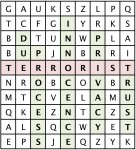
Fear. Fear is paradoxically a powerful motivator and pacifier. It compels us to fight back but sometimes can lull us into complacency if we believe such complacency will protect us. It was recently revealed that the NSA been collecting “metadata” from American’s phone conversations and recording the content of our internet usage in a furtive attempt to uncover the word “TERRORIST” in a virtual global-size Word Puzzle.

terroristPuzzle.jpg

After this revelation there was much popular indignation. Liberal, libertarian, and conservative – all briefly joined together in outrage that their government would subject them to such scrutiny. We all (naively) believed our internet communications to be private; thus our outrage over such virtual eavesdropping was no different than had the NSA been bugging our bedrooms. Then something happened. The government did not blink. They were not at all shamed by this revelation. In fact all three branches of government defended it on the grounds of safety. Or the illusion of safety anyway. Without the PRISM program (the codename for the internet spying) we might have fallen victim to dozens of terrorist attacks, so they say. The brushfire of outrage was all but quenched with the bucket of our own fear – “well I guess it’s ok if it will keep us safe” now says John Q. Public.

How many violations of our liberty will we accept to keep us safe? Since we generally value our lives more than anything else it is safe to say we will tolerate quite a bit. And those in power know this. That is why historically such appeals to “protecting the people” have always been the siren call of despotic regimes intent on accruing more and more power to themselves. Such appeals to “safety” give them a carte blanche to inflict just about any measure of control over the citizenry. The trick though is that it must be done piecemeal. You would notice a million ants at your front door, but one or two sneaking in under the door each day are hardly noticed at all. Given enough time eventually all the ants are inside and by then it is too late.

Rather apropos was Anton Scalia’s dissent  last week in an unrelated case, “Solving unsolved crimes is a noble objective, but it occupies a lower place in the American pantheon of noble objectives than the protection of our people from suspicionless law-enforcement searches.”

Yes indeed we could find more criminals if police could search any house they wanted any time for any reason. If we required every citizen to provide a DNA sample or undergo a psychological evaluation we could prevent many crimes. If we could bug every home, building and car we could surely catch a terrorist or two. But is that the country we want to live in?

We can speak of balancing liberty and privacy but by what non-arbitrary method can one find that balancing midpoint? There is none. The need for safety is always immediate whereas the need for liberty is less exigent; therefore in a contest between the two, liberty tends to lose out. We don’t realize we need liberty it until it is long gone.

But this whole question of balancing the two ignores the elephant in the room. How did we get here? How is it that we have the tiger by the tail? Even though Ron Paul was ridiculed for bringing the question up 6 years ago (as though to merely pose the question is to be guilty of being un-American), we still are not addressing why America is a terrorist target (short answer: our interventionist foreign policy).

If our boat is sinking, the immediacy of safety demands we bail out the water, but perhaps it would be prudent to find the source of the leak instead of focusing all energy on mitigating its effects. Reacting to the effects of something we are willfully blind to is the definition of futility.

On Voluntaryism, Stateless Societies and Contract Slavery

Recently I got involved an interesting philosophical discussion on Facebook (where else!) concerning taxation and the proposition that if you don’t pay your taxes men with guns will come and take you to jail or kill you (all true). One participant brought some focus to the conversation by distilling down the core argument to one of a) should we have government (b) how shall we pay for it (c) constitutions are like contracts. All good points, however embedded in each one is either a false choice or a fallacious assumption. So below I will reproduce his post and then my follow up as I address some of the main fallacies. 

here is the quoted content from the post I will be responding to:

This conversation, and every conversation about the scope of govt comes back to the same place. The first division is you are either an anarchist or you want some kind of law. The moment you say you want some kind of law, you are agreeing that at some point in the process of enforcing the law, a dude from the govt with a gun will come take you away. And I am okay with that – no point in pretending we have laws if they are not going to be enforced.I am willing to listen to discussion, but anarchy is probably not for me, or most of us. So then it’s like the old joke about the prostitute – we’ve already established what you are (pro-govt of some kind), now we’re just haggling over price. Where is the line in the sand as far as your philosophy of the proper scope of the law?I would suggest that the only useful argument by a libertarian about government is that it ought only exist to prevent one adult from using force or fraud to gain from another adult – whether that gain is via money or to forward an agenda. Situations involving children and the mentally impaired are naturally given to tighter governance.So to me, the idea that we’re arguing over whether or not you must / ought pay federal taxes so the govt can fund its activities is a little pointless. The only real argument for strict Constitutionalists or libertarians ought to be about the USE of the money, not the government’s right to take it. The law of tooth and claw was used to appropriate the land upon which I sit and afterward to create the govt that exists here – the RIGHT is almost irrelevant. Were I to be successful in dissolving this (formerly) useful govt, it is most likely a worse govt would take its place. There is no perfect freedom on this side of heaven, so the notion that no entity can curb my inclinations or bind my freedom is almost childish.We can get into a lot of philosophical discussions about man being created free and whatnot, but the fact is that there will be some govt, and we enter into “contracts” (the Constitution, say) with other free people to create these govts that will enforce our individual rights to property and to secure freedom from invasion, etc. With our ancestors having agreed to some form of these contracts, and most of us agreeing that they ought to exist in one form or another, we should be focused on the quality of the contracts, not the terms of enforcement.

Here is my response:

Your points I think have helped to focus the discussion, however the underlying assumptions simply reinforce the false dichotomous choice that is beaten into us from day one (by our educators, our literature and the state media) – namely that one has a choice of either being ruled by others (in the form of this thing we call government) OR absolute and total chaos with no laws or order whatsoever. Obviously with a choice like that who would pick the latter? And to an extent I think part of the failure for the proper alternative being made understood falls at the feat of us libertarians – we (or some of us) throw the word “anarchy” around and do not explain at all what is intended by the use of that phrase. I personally prefer “voluntaryism” – it’s enough of a neologism that it carries none of the associated emotional baggage of “anarchy”. We want the freedom of choice. Not the freedom to state our choice and have it vetoed by a “majority”, but to actually be allowed to execute our choice.


When we libertarians speak of “freedom from government” we do not intend a lawless, chaotic, anything goes sort of wild west world. Far from it. We want government. We want order. It’s just that we want to pick our own government to associate with. And we do not believe that simply because I happen to live next door to you and you want to associate with a government that establishes rules that promote Ideology A and I want to associate with one that promotes Ideology B, your choice should have any bearing on my choice. 

Think about it for a minute. I’m proposing something no more controversial than what we currently practice today – freedom of religion. If I’m Catholic and I live in a town full of Baptists it would seem ludicrous to anyone to suggest that “well since a majority of people who live here are Baptist, well, you have to be Baptist too, or at the least you have to do all the things the Baptists require” – and that if I didn’t comply I would be throw in jail. That’s insane – and rightly so, and everyone would agree that that would be insane. And so it is no different with government. This type of governance is not unknown. It is sometimes referred to as a “clan” system. In more “primitive” stateless societies families had a self-interest in protecting each other. They came to each other’s defense and helped each other in times of need. In time it became customary for non-family members to join a family or clan for such protection purposes (voluntarily paying or contributing something in return – i.e. truly voluntary “taxation”). However all members of the clan were responsible for the behavior of its members. If one member injured someone in another clan then all members must make restitution. They then obviously had a self-interest in preventing such behavior from those they knew to be the most troublesome. Eventually if a member behaved badly enough consistently enough they were thrown out of the clan and thus had no protection of any kind from any group. They were an “outlaw” – which meant that anyone could kill them, rob them whatever without any consequence whatsoever. That’s a pretty big incentive to not become an outlaw and behave as directed by the customs and laws of your clan. (For a brief discussion of this system in Ireland please see this interview with Gerard Casey by Tom Woods ). In order for all clans to get along they tended to adopt the same basic “common laws” against violence, theft, rape, etc. So in this way we can see how “law” can exist without an over arching state. Everybody is against rape and murder. But not everyone might be for space exploration, or green energy, etc. Essentially each clan is a government, the only difference being they did not have specific geographical boundaries. Members of multiple clans could all live in the same city and get along just fine. There is no reason such a system could not operate today on a larger scale, one where entities very similar to insurance carriers took the place of the role of government in dispute resolution, restitution, crime mitigation (less crime, less to pay out in losses). If such an entity does not provide what people want, they will go elsewhere. Without a barrier to entry imposed by outside regulations no one could ever “take over” such an industry, the market would always be providing those that could do it better, faster, cheaper, etc.

This has gotten a lot longer than I intended, but let me just touch on another point you made. The one of contracts is germane, however you again accept the “party line” that the fact that our ancestors freely entered into a contract (the Constitution) somehow morally binds us to that same contractual obligation in perpetuity. How can it? Are we bound by the contracts our parents sign? If your parents had a huge amount of debt and then died would you want to suddenly be saddled with that? What if I could vote myself out of the contract, but my siblings wanted to remain party to it, and thus I was then bound by their vote – why should I be bound by their choice? There really is no difference between that and the idea that we are all still adhering (or pretending to adhere) to a contractual document signed by people that have all been dead for nearly 200 years. I talk about this idea of contractual slavery more here
The Magic of Democracy

Jon Stewart (The Daily Show) had a humorous take on the recent IRS scandals (see clip here) however what I found most interesting in his monologue is what I believe may be the most succinct summation of the core belief system of all progressives/socialists:

“I believe…that good government has the power to improve people’s lives and that the people have the power to restrain its excesses.”

Within this statement are two fallacies. Let’s deal with the first one. Although government can in theory improve people’s lives, the fallacy is in the unspoken assumption that government is the only agent in society that can accomplish such goals. Using government to improve people’s lives is like using a hammer to drive in a screw – it can get the job done eventually but there are far more efficient ways to accomplish the task.

The second half of the statement, however, yields the much more interesting and widely held fallacy. It embodies the fatal naiveté of those who believe democracy is the most perfect form of government. Democracy provides us with the comfortable illusion of self-determination and control while in reality providing no such thing. As we ride the majority wave we delude ourselves into thinking we control the wave, but we do not. One second we are high on the surf, the next we are plunging downward as we are pulled out to sea against our will. We do not control the mob, the mob controls us.

No system is perfect but monopoly governance short circuits the natural feedback mechanisms that would otherwise eliminate abuses. To naively believe “reform” can fix our present woes is to ignore man’s basic instinct to obtain more with less effort. When this instinct is set loose in monopoly government the result is cronyism, when set loose in the market the result is innovations and efficiency improvements.

Some believe the government feedback is not broken, that it is the polling booth that provides this check on abuse. This does seem plausible – “vote the bums out” as they say. Unfortunately, this feedback fails to effect change as long as only a minority is abused. The minority can never garner enough votes to “change” things and everyone else is indifferent as long as they are not being affected. The majority is pandered to by promises of favoritism at the expense of the minority. And so nothing changes. If businesses were run like government (wherein employees voted for the boss that promised them the biggest pay increase) is it not obvious such selfish self-interest would eventually lead to financial collapse? The size and scope of government debt serves as testament to the accumulation of just such abuse. A private entity could never have accumulated so much debt and would have been extinguished long ago.

Voting on who runs the government makes about as much sense as voting on who should run Publix. Publix sells us goods and services and so does government – why does Publix have to compete for our dollars but government does not? Why do we vote for government leaders but not Publix leaders? One word: taxes. Taxes are compulsory. Voting mollifies the masses into the delusion that they have chosen this compulsory state in much the same way a corralled animal chooses its path. A leashed animal is restless and fights the leash. But, remove the leash and allow it to roam free on fenced pasture and it will cease all resistance. The illusion of freedom is quite powerful.

The Truth Emerges…

What are the lessons from the recent IRS scandal surrounding the targeting of conservatively named groups for heightened levels of tax status scrutiny? Is it that there is a vast left-wing conspiracy in this country and this is just the tip of the iceberg? Is it that Obama is the fiendish mastermind behind these directives? Although neither is impossible, the likelihood of either scenario is dubious at best. Conspiracy theories that involve the government are a peculiar sort. They are often germinated by those who assert on one hand that government is as effective in its stated goals as a flopping fish but then on the other hand claim that when it comes to the conspiratorial acts it possess the organizational acumen of a stealthy ninja.

This scandal demonstrates not the intent of a scheming mind but rather is a mockery of the hubris of those who believe “we” or anyone can “control” an entity as large as government. From the complexity of such large entities there emerges certain properties that are neither predictable nor directed (in biology known as “emergent properties”). The emergent property we are seeing here is “selective enforcement.” We tend to think of government as this monolithic entity acting with a singular will. This interpretation turns a blind eye to the obvious truth that “government” is composed of freely acting individuals who can, and often do, whatever they wish. They act with impunity, reaching out from behind the collective government shield that protects them. Occasionally the shield is pierced, as with the IRS scandal, and we are allowed for a brief moment to bear full witness to the results of granting our agent (government) absolute autonomy over ourselves.

The fact that the outrage around this scandal is so misdirected is a testament to how inured we have become to government intrusions. The scandal should not be that these rules were selectively enforced but rather that such rules exist at all! Abstractly the scandal can be as summarized as follows: the rules say everybody that wants a cupcake must have their knees smashed with a baseball bat. But that takes too much time and energy, so they just started smashing in the knees of people they didn’t particularly like. Then people got upset because it was unfair they weren’t bashing in everybody’s knees. We’ve been beaten down so long it seems almost “crazy” for someone to suggest perhaps the beatings should stop (yes – I mean this metaphorically people.)

But, what can we expect when we have granted fallible, petty, capricious human beings nearly unlimited power over other fallible, petty, capricious human beings. How does slapping the label “government” on one group magically change their nature? It doesn’t, and that’s the problem.


Unwise Actions

This week I am setting aside the usual politically inspired thoughts. Frankly my heart just isn’t in it. My wife and I (along with thousands of others) have been vicarious witnesses to every parent’s worst nightmare: the death of a child. A close friend, teammate and classmate of our son’s took his own life last week. There were no warning signs. To say we are all shocked would be a gross understatement. This tragedy has reminded us all how quickly that which we take for granted can vanish in an instant. The pain and anguish we have experienced have been but mere shadows of what his family has endured. I am humbled by their strength of character for I doubt I could muster the strength to get out of bed. Many ask “why” in these situations but it may be the most pointless question of all. There is no answer that could ever be given that would make any sense or console anyone. We hope an answer might help us prevent others from doing the same. But every situation is unique. Following our hindsight leaves us blind to what is before us. The challenge is not in addressing every potential scenario that might lead a teen down this path but rather in making sure they understand there does not exist even the possibility that any event or situation in their life could ever justify such a course of action.

As parents we face a real challenge. We wish to set standards while simultaneously not undermining those standards through the moral hazard of our love. I think we are all often guilty (myself included) of saying “Do this, don’t do that” and leaving the “but if you fail it’s ok, we’ll still love you” as an unspoken sentiment. We know we’ll love them no matter what but we have to be mindful of how when we were teens we felt like our parent’s love (respect, approval, etc.) for us was conditional upon our meeting their standards. As a parent don’t assume anything – tell your kids you set standards because you love them but if they fail it will not affect your feelings in any way. Tell them that you don’t expect perfection, that none of us are perfect least of all ourselves. Children instinctively place their parents on a pedestal as paragons of perfection. It’s ok to let them know that is not the case, that we are human and make mistakes just like they do. I think taking ourselves down a notch in their eyes may often help to lift them up a notch so that in their eyes the gap between us is much smaller – perhaps small enough to maintain communication (a real challenge in the teen years).

And to any teen or young person reading this, please understand there is NOTHING that you could do or experience that would warrant taking your own life. Grades, relationships, drugs, life goals – problems in these areas are nothing more than pebbles underfoot on the journey of a thousand miles that will be your life experience. Don’t let a few pebbles stop you now. If you feel you can’t talk to your parents then talk to anybody, a friend, a teacher, a stranger, anybody. And if that doesn’t help, just wait 24 hours before doing anything you can’t undo. Emotions are fleeting and mercurial; it is unwise to act based on your emotional weather vane. Whatever pain or fear you are experiencing will be magnified a billion fold in the family and friends you leave behind.


if you would like to learn more about the events that inspired this column, please see this page here.

Perverse Incentives Promote Disasters

In the wake of any industrial accident there follows a predictable chorus of pundits lamenting “market failure” in order to justify further interference of the state into every facet of business function. On the surface this might sound plausible, surely we need Big Brother looking over our employer’s shoulder to make sure everything is safe, right? The only problem with this narrative is that the pundits tend to conveniently omit the crucial fact that such disasters happened on the watch of government. There is no place in the world immune to at least some level of government oversight related to safety. Even in Bangladesh where there has been a recent spate of factory fires and building collapses they at least had building codes even if they weren’t followed. And there in lies the rub. The people entrust their government with the task of ensuring their safety (a dubious decision at best) but when that same government fails to adequately carry out that mandate and such failure is the proximate cause of some disaster oddly blame is 100% shouldered by the regulated entity rather than the regulator. If you had a jail in your community that routinely had prisoners escaping and killing people it seems like at some point the people running the prison should share in the culpability.

So whether it is financial misdeeds on Wallstreet, a factory explosion in West Texas, or a building collapse in Bangladesh, we see the same failure of the state regulators to do their job. But the regulators are just employees, they can’t be held personally liable. And their employer is the state, and the state can’t be held liable. So where does that leave us? No one is responsible. What is the solution? Rub some bacon on it – err I mean throw some more money at it.

If regulators fail, then they just get more money and scribble down yet more regulations based on their clairvoyant 20/20 hindsight; more words on paper that will be ignored by more regulators in the future. The perverse incentive of this system should be obvious and yet it continues. The perverse incentive is that (a) failure is rewarded with (b) more resources; therefore failure is what is incentivized. Now that is not to say that all the regulators individually are these evil monsters failing on purpose in hopes of one day obtaining a raise. But what it does mean is that the system itself cannot cure itself. A market system is self-regulating in that failing firms (assuming they are not bailed out by the government) disappear into the graveyard of failed businesses. In a market based regulatory system failure means you lose all your money and go out of business. Success means you make money and you stay in business. Competition among the successful firms drives further improvements. There is no competition in the monopolistic government run regulatory system; Soviet style stagnation reigns supreme. A successful private regulator (e.g. Underwriter’s Laboratories, Consumer Reports, etc) prevents harm and is rewarded for successfully doing so. Government can’t go “out of business” and so the same old failing system stays in place, at least until we vote in illusory “change” only to discover nothing has changed at all.

Bangladesh Robber Baron fallacy

Just read this article about the Bangladesh factory disaster this morning. Truly terrible what happened, however the usual progressive/statist smugness comes to the surface pretty quick in the comments “oh see what the free market causes, we need government to save us from these evil people.” Here’s my response on the board to that sentiment (longer article coming this weekend):

Except that the “Robber Barons” is a progressive statist myth. Please see Tom Woods on this: http://www.youtube.com/watch?v=BbIIPtLEVbA

Basically those that compare working conditions of the late 19th and early 20th century or those in emerging 3rd world countries to those today in the US are guilty of a “ceteris paribus” fallacy, that is, you are making a comparison and drawing a conclusion that is flawed because not all of variables are held constant, namely the variables wealth and technology in a given society. Do people value safety? Sure, but value is subjective and we arrange things on our value scale ordinally (we rank them in order of preference). Do we value safety MORE than we value not starving to death? I think not. So if our choice is a) not starving to death or b)comfortable/100% certainty of safe working conditions we will choose (a) every time. We will work so that we can buy food and not starve to death and we will do so in an environment that while not ideal is the only option available and in fact is the better of all other options available.

Now I’m not excusing the owners of that building/business for building an unsafe building, but consider the alternative proposed by progressives. Government mandating to the nth degree every aspect of building design. It would cost so much to build that building there that they simply would never have built it, and thus there would have be NO jobs for anyone and they would have been left to scratching in the dirt to make a living. Is the current outcome good? No, but it is still BETTER than the alternative, where instead of 1000 people dying and 2000 surviving maybe 2500 die of starvation and 500 live through subsitence farming.

They likely built it this way because of crooked govt, paying off inspectors, and never thinking they could get in trouble. In a free market there is no one to pay off. They would have built it better knowing 100% with certainty they would go to jail were it built shoddily

The Fallacy of Prevention

Gun Control Advocate: “We need more/better gun laws to eliminate gun violence.”

Gun Rights Advocate: “Gun laws do not decrease gun violence because criminals do not follow the law.”

Gun Control Advocate: “So we should just get rid of all laws because they fail to stop all crime?”

And that’s where this little exchange usually ends. The gun right’s advocate typically stutters through some non-sequitur argument that doesn’t at all address the apparent “gotcha” from the now smug gun control advocate. Sadly courses on logic are no longer taught in our schools, because if they were, we would easily spot logical fallacies such as this one. This is an example of a false analogy or comparison, that is, assuming two things are equivalent and inferring they must share the same properties. Not all laws are the same.

Laws against violations of person or property (murder, rape, theft, etc.) are primary laws. Their sole function is punitive. They prescribe the consequences for violation of the law. If the consequences are severe enough there may be a small preventive tendency but overall people breaking these laws really aren’t concerned with the fact that somewhere there are words on a piece of paper saying they shouldn’t do such and such. In short, these laws can only affect criminals (i.e. those who broke the law).

Laws like gun control (i.e. interventionary laws) are secondary laws. They attempt to prevent the violation of a primary law through interventionist procedural means. Whereas primary laws affect only their violators, secondary laws affect only non-violators of the related primary law. Prospective violators of a primary law simply ignore the demands of the related secondary law. Because there is no way to know who these potential violators might be, secondary laws must by necessity cast a wide net and attempt to inconvenience everyone. Sadly they fail in their attempt, they catch all the fish you don’t want and allow all others to escape. In short, these laws can only affect non-criminals.

And so the fallacy is exposed. Abstractly it is implied that gun laws (“B”) are beneficial because: eliminating primary laws (“Not-A”) is “bad”, therefore “A” is “good”, and because “A” is assumed to equal “B”, it follows that “Not-B” is likewise “bad”, and so “B” must be “good”. As I’ve shown above A does not equal B, and without that the argument fails.

Laws against murder ARE anti-gun laws. They are also anti-knife, anti-bomb, anti-poison, anti-anything that could be used to kill someone. Laws against specific types of weapons are a fear driven whack-a-mole style attempt to prevent future violence. The futility of this preventive approach is clearly seen in our nation’s prisons. In the most highly controlled, rights restricted environment one can imagine there are still drugs, there is still violence, and there is still murder. If preventive efforts fail in prison, how could they possible be expected to work in a free society? Some often cite Australia’s stringent gun controls laws of 1996 as proof that tight restrictions can “work” by pointing to the drop in gun violence since enactment. While such violence has dropped, what they conveniently leave out is that the statistics clearly show the rate of gun violence was already on a decades long decline prior to and after the 1996 laws. In fact armed robberies had a dramatic increase shortly following the new gun restrictions. I don’t suppose that had anything to do with the fact that criminals opted not to follow the law and instead kept their guns?