Daily Archives: 2011-04-25

Math 101

Let’s do some simple math.

2011 Federal Budget: $3.8 Trillion

2011 Federal Revenue (est): $2.6 Trillion

so

$3.8 – $2.6 = $1.2 Trillion Deficit

100% of all personal income above $200,000 per year = $1.2 Trillion.

So there you go, I guess the President is right after all. The solution to our deficit problem is so simple: take ALL of the income of the “wealthy” above $200,000 per year (in addition to the taxes they already pay on the amount below $200,000 which would effectively be an 83% total (not marginal) tax rate).  I guess “fair share” or “shared burden” is code for “no one should make more than $200,000 per year”.

And just to disabuse anyone of the notion that corporations are where the real money is: the combined income of everyone making more than $200,000 per year exceeds the combined income of EVERY corporation in the country ($2 Trillion vs $1.2 Trillion – and no I’m not double counting, these are C-Corporations only). Indeed, the combined AGI of every US Citizen is $7.5 Trillion vs only $1.2 Trillion for every corporation. Why is individual income so much more than corporate income? Payroll is the single biggest expense for corporations. Median profit is only 5% of revenue whereas Payroll is 18%. That’s right, companies pay more to their workers in salaries than the company itself retains as profits.

So what is my point? Obviously I’m not actually advocating 83% absolute tax rates on the “wealthy” (hopefully I haven’t given the Democrats any ideas!) My point is that spending is the problem, not revenue. Even returning to the much-touted “Clinton era” tax rates would not even begin to make a dent in the federal deficit. The rate of increase in the federal budget from 1980-2000 was a consistent $60 billion/year, but starting in 2001 the rate of increase jumped to $150 billion/year and in 2009 jumped even further to $240 billion/year. Clearly Bush got us off course spending wise and Obama has made it that much worse.
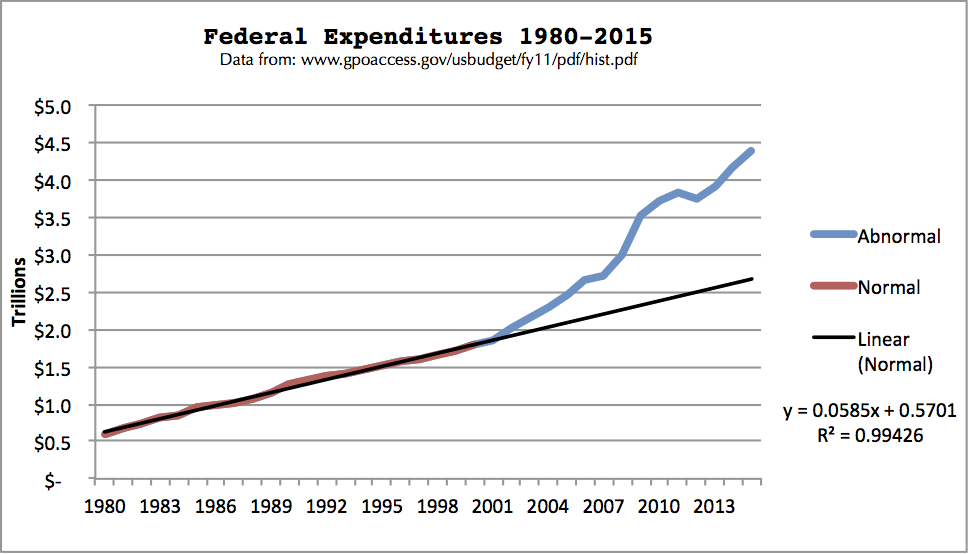
If we were to return Federal spending to the 20 year trajectory it was on when we got off course in 2001 the Federal Budget for 2011 would be a “mere” $2.4 Trillion. That’s right, we’d actually be in surplus EVEN with the Bush tax cuts. For a detailed outline of how this could be achieved please see this Reason article. The Cliff notes version is this: no sacred cows, EVERYTHING (defense, social security, Medicare, entitlements, etc) must be cut.

All values obtained at: www.irs.gov/taxstats/ and are for the latest years with available data.

Productivity kills Jobs?

Recently Congressman Jesse Jackson Jr. (D-IL) remarked that Apple’s iPad was “probably responsible for eliminating thousands of American jobs.” Further, he tried to link it to the recent bankruptcy of Borders Books as well, quipping that “Why do you need to go to Borders anymore? …just buy an iPad and download your book…”

Wow.

Such an expression of sheer ignorance of basic economics is astounding. And from a sitting U.S. Congressman no less makes it all that much more sad and appalling. But I guess I shouldn’t be too hard on Jesse. This fallacy has been with us for a long time. Every time some new tool that enhances productivity (and thus lowers costs) is introduced it is decried as terrible because it will put so many out of work. The benefits (lower prices) are ignored. But after awhile the controversy dies down and we’re all much happier to be paying less for our robot built cars, our sewing machine made clothes and our machine harvested food.

So why does this myth persist? Well quite simply because it is true – people do of course lose their jobs – in the short term. However it is disingenuous to evaluate productivity gains over a narrow time frame and summarily conclude the outcome as negative because a few will lose jobs.  That’s like planting seeds and a day later noting that nothing has yet sprouted therefore the seeds must be worthless. Productivity gains take time to take root and spread their fruit of lower prices throughout the economy. As people spend less money on the newly cheaper goods they now have more money to spend on other goods. The increase in demand for these “other goods” drives job creation. Of course it does take time for people to retrain or to move to where the new jobs are, it doesn’t happen overnight. That’s why we have Unemployment Insurance. In the “big picture” there are no job losses, in fact there will be net job gains if the productivity enhancements are sufficiently large.

But some inevitably want to prevent the process from ever starting because of short term fears, thus they use the power of government to act as a break to these productivity gains. Government will either subsidize the outmoded industry or attempt to penalize the new entrant through punitive taxes or burdensome regulations. This only happens of course if the “harmed” industry has a sufficiently well funded lobbyist group. This explains why sugar is more than twice as much in the US than in all other countries (due to the trifecta of tariffs, quotas and subsidies) whereas typewriters have practically gone the way of the Dodo. Government meddling in the market simply makes the process take even longer (we’ve been waiting since 1812 in the case of sugar!) by eliminating most if not all of the cost savings achieved and thus the net additional jobs that could have been created.